Mahindra Thar E: Price, Launch Date, Range, and Full Specs
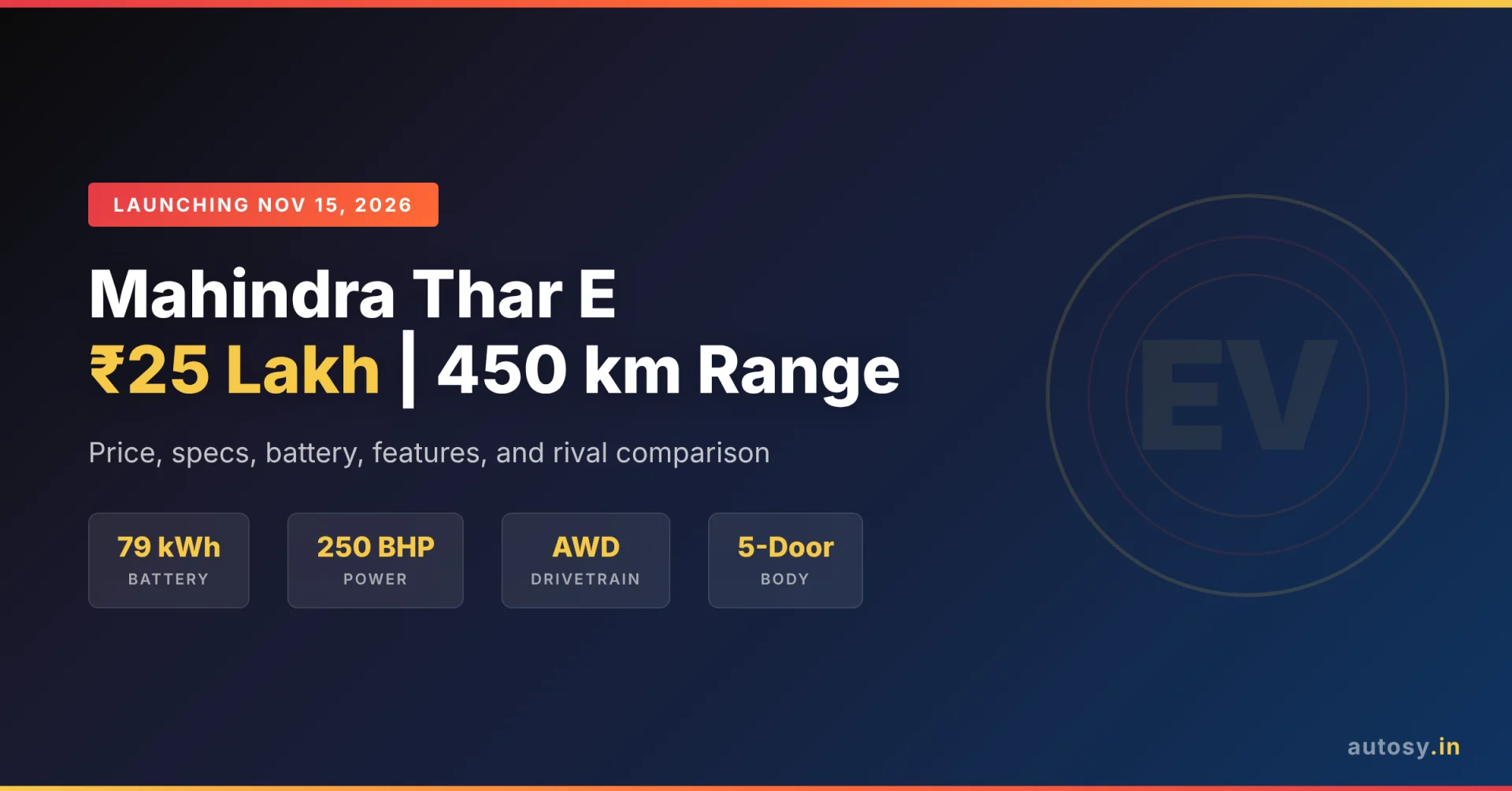
The Mahindra Thar E launch date is confirmed for November 15, 2026. Expected Thar E price starts at ₹25 lakh (ex-showroom). This five-door electric SUV rides on Mahindra’s INGLO EV platform, packing a 79 kWh battery good for a claimed Thar E range of 450 km and 250 bhp from dual electric motors with all-wheel drive.
Three years from concept to production. That is fast by Mahindra standards.
How We Got Here
Mahindra showed the first Thar E concept in South Africa in 2023. The Vision T concept, much closer to production, followed on August 15, 2025. Behind the scenes, Mahindra confirmed 16 new launches by 2030 and committed ₹15,000 crore to a new EV plant.
Mahindra Thar E Expected Price and Variants
Mahindra is expected to price the Thar E from around ₹25 lakh (ex-showroom). For context, the on-road price in Mumbai could touch roughly ₹29.25 lakh once you add registration and insurance. That said, EV buyers in several states benefit from reduced or zero road tax, which could bring the effective cost down.
At that price point, the Thar E sits above its direct electric rivals. The Tata Sierra EV starts at ₹18.79 lakh, the Hyundai Creta Electric at ₹18.02 lakh, the MG Hector Tomahawk at ₹19.50 lakh. Mahindra is pitching this as a premium electric off-roader, not a volume play.
Expect two or three variants at launch, likely a rear-wheel-drive base and a dual-motor AWD option at the top.
Battery, Range, and Performance
Under the skin, the Thar E gets a 79 kWh lithium-ion battery pack sourced through Mahindra’s partnership with Volkswagen on the INGLO platform. The claimed range sits between 450 and 500 km on a full charge (ARAI cycle), which should translate to roughly 350 to 400 km in real-world mixed driving conditions.
Power output: 250 bhp from dual electric motors, fed through an all-wheel-drive system. Not a gimmick. Mahindra has been vocal about keeping genuine off-road ability in the Thar E, so expect dedicated terrain modes and a low-range equivalent for the trails. DC fast charging should get you to 80% in under 45 minutes.
Design and Features
The Thar E keeps the squared-off, upright stance that defines the Thar family, but with a cleaner face and sealed-off front end typical of EVs. It is a five-door, five-seater body, closely following the proportions of the Thar Roxx but with unique EV-specific styling cues picked up from the Vision T concept.
Mahindra is loading the Thar E to compete with premium SUVs on features. A large touchscreen with wireless Android Auto and Apple CarPlay is expected, alongside a fully digital instrument cluster and ventilated front seats. The panoramic sunroof is worth noting since neither the Sierra EV nor the Creta Electric offers one as standard. Wireless phone charging and a powered tailgate round out the comfort kit.
Safety is where things get interesting for the Thar E specs sheet. Level 2 ADAS with adaptive cruise control and automatic emergency braking should be standard. Six airbags across all variants is expected too.
Mahindra Thar E vs Rivals: Quick Comparison
Here is how the Thar E lines up against its closest competitors on paper:
| Spec | Mahindra Thar E | Tata Sierra EV | Hyundai Creta Electric | MG Hector Tomahawk |
|---|---|---|---|---|
| Price (ex-showroom) | ~₹25 lakh | ₹18.79 lakh | ₹18.02 lakh | ₹19.50 lakh |
| Battery | 79 kWh | 61.7 kWh | 51.4 kWh | 50 kWh |
| Range (claimed) | 450+ km | 502 km | 473 km | 400 km |
| Power | 250 bhp | 201 bhp | 169 bhp | 175 bhp |
| Drivetrain | AWD | FWD | FWD | FWD |
| Body style | 5-door SUV | 5-door SUV | 5-door SUV | 5-door SUV |
The Thar E costs more. But it brings a bigger battery with more power, plus AWD, to a segment where every other option is front-wheel drive only. If unpaved roads and weekend trails matter to you, the Thar E is the only electric option that takes them seriously.
The Mahindra BE 6 Sporteq at ₹19.45 lakh is the other Mahindra EV worth a look, though its coupe-SUV styling targets a different buyer.
Should You Wait for the Thar E?
If you are already eyeing a Mahindra Thar Roxx but curious about going electric, the Thar E makes the decision interesting. You get the Thar character without the diesel engine’s maintenance overhead, plus instant torque that should make both highway overtakes and low-speed crawling effortless.
The ₹25 lakh asking price is steep compared to rivals, but keep in mind that EV running costs are dramatically lower than ICE equivalents. If you clock high monthly kilometres, the savings on fuel alone can offset the premium over three to four years.
That said, if off-road capability is not a priority, the Tata Sierra EV and Hyundai Creta Electric offer solid range and features at significantly lower prices. The Thar E’s real sweet spot is buyers who want a proper SUV that can go off-road and also happen to want an EV. For that specific niche, nothing else in India quite matches it.
With India’s electric car sales growing steadily and more capable off-road SUVs arriving, the timing works. Wait for November 15 to see confirmed pricing and variant details before booking anything.
