Electric Car Sales Surge 76% in October 2026: 14 Brand Breakdown
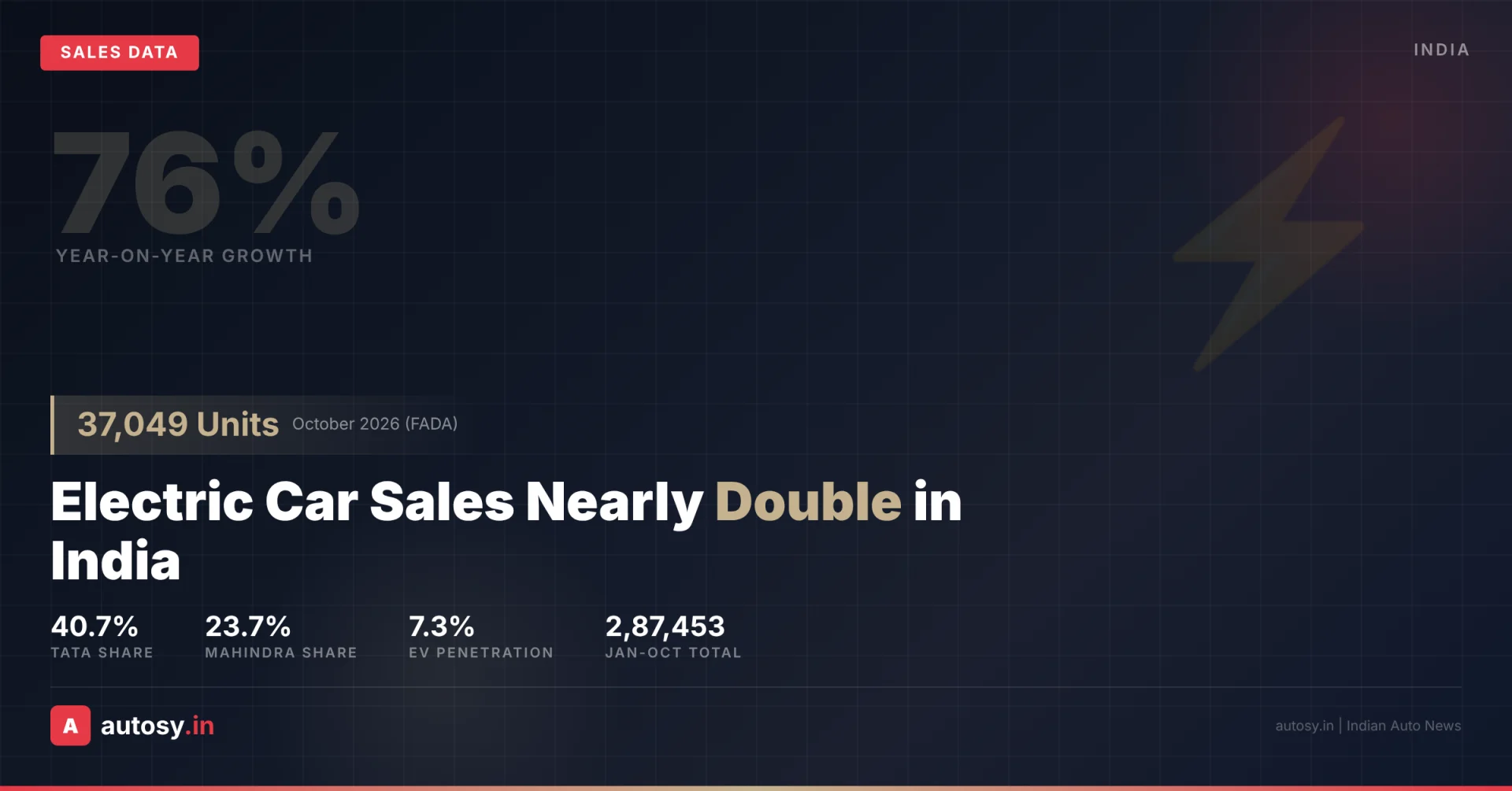
Electric car sales in India for October 2026 nearly doubled compared with the same month last year. The Federation of Automobile Dealers Associations (FADA) reported 37,049 retail units during the month, up 76.47% from 20,995 units in October 2025. That one number captures a market in the middle of a structural shift: every seventh new car registered in India now plugs in rather than filling up.
The growth also pushed EV penetration to 7.3% of total passenger vehicle sales, compared with just 3.5% a year earlier. It marks the fifth consecutive month that monthly EV volumes have stayed above the 30,000 unit mark, a threshold the market first crossed in June 2026.
Tata Motors Holds Firm at the Top
Tata Motors retained its position as India’s largest electric car seller with 14,669 retail units in October, recording 77.6% year on year growth. The company’s steady sales momentum through 2026 owes a lot to its spread across price segments. The Tiago EV covers the entry level, the Punch EV and Nexon EV sit in the mass market sweet spot, and the Curvv EV and Harrier EV address buyers looking for more space and range.
That portfolio breadth kept Tata’s market share at 40.7%, barely changed from 40.5% in October 2025. However, the monthly trend shows a 0.82% dip from September, a small sign that rivals are pulling harder.
Mahindra Closes the Gap With Record Numbers
Mahindra’s electric push is delivering results. The company registered 8,538 units in October, an 85.7% annual increase from 4,599 a year ago. That pace outstripped the overall market growth of 76.47%, lifting Mahindra’s share from 22.5% to 23.7%.
Mahindra also posted a 9.74% month on month gain over September (per FADA data), suggesting the BE 6 and XEV 9e are finding consistent demand. Together, Tata and Mahindra now control 64.4% of India’s EV market. A year ago, that combined figure was closer to 62%, underscoring how domestic manufacturers are tightening their grip even as international brands enter.
MG Loses Ground Despite Positive Growth
MG Motor India sold 5,939 electric cars in October, up 10.8% year on year. Under normal circumstances, double digit growth would be encouraging. In a market expanding at 76%, it amounts to falling behind.
The numbers bear that out. MG’s market share dropped from 26.3% in October 2025 to 16.5%, a loss of 9.8 percentage points. That’s the steepest decline among all listed manufacturers. The Windsor EV remains the backbone of MG’s electric strategy, supported by the Comet EV and ZS EV, but the lineup hasn’t broadened fast enough to match the pace set by Tata and Mahindra.
VinFast Emerges as a Serious Contender
Vietnamese automaker VinFast registered 2,571 units in October, up from just 142 a year earlier. While that 1,710% figure reflects a small base, the absolute volume is significant: VinFast now holds 7.1% of the market, ahead of Kia, Maruti Suzuki, Hyundai and BYD.
The company entered India aggressively with competitive pricing on its VF e34 and other models, and the October numbers confirm it has moved past the launch phase into sustained retail volumes.
Maruti Suzuki’s EV Entry Begins to Register
Maruti Suzuki sold 1,200 electric cars in October, its strongest month yet since the e Vitara went on sale earlier this year. With no comparable figures from October 2025 (the e Vitara hadn’t launched), year on year growth isn’t applicable, but the 8.70% month on month increase from September indicates steady traction.
At 3.3% market share, Maruti’s numbers are still modest relative to its dominance of the overall car market. The real question is whether the company’s unmatched dealer network (over 4,900 outlets) can convert conventional buyers into EV customers over the next 12 months. For first time EV buyers weighing the switch, Maruti’s showroom proximity could tip the decision.
The Rest of the Field: From Tesla to Toyota
Several other brands are building their positions, though none yet challenge the top three.
Kia registered 1,395 units (up 85.3% YoY), driven by the Carens Clavis EV and EV6 across different price brackets. Hyundai posted 760 units, a 42.3% annual gain, though its 2.1% share is down from 2.6% a year ago. BYD managed 737 units with just 4.1% growth, its market share slipping from 3.5% to 2.0% as it struggles against the faster scaling Indian and global competitors.
BMW sold 462 units (up 26.6%), maintaining its lead in the luxury EV space. Tesla recorded 291 registrations, a 627.5% year on year increase from a tiny base, as its India operations continue to ramp up. Toyota registered 190 units, and the Mercedes Benz GLC Electric (launched recently at ₹78.50 lakh) contributed to the brand’s 62 unit tally, though that figure fell 48.8% compared to last October.
EV Sales in India: 2026 Has Already Eclipsed All of 2025
Between January and October 2026, India recorded 2,87,453 electric car registrations (per Vahan data). That total already exceeds the 1,76,817 units registered during the entire 2025 calendar year. With November and December still to come, including the festive buying season’s tail end, the full year total could approach 3.5 lakh units.
The pace suggests this isn’t a one month spike tied to Navratri or Dussehra discounts. Five straight months above 30,000 units points to a structural shift driven by more models across price points, expanding charging infrastructure, and rising fuel costs that make the total cost of ownership argument for EVs harder to ignore.
What the Numbers Mean Going Forward
October’s data reveals three clear trends. The Indian EV market is consolidating around domestic players: Tata and Mahindra together hold nearly two thirds of the segment, and that share is growing. Mid tier competition is also intensifying, with VinFast, Kia and Maruti Suzuki all fighting for the 3% to 7% band.
Any breakthrough model from those brands could reshape the standings quickly. Meanwhile, premium and luxury EVs (BMW, Tesla, Mercedes) remain a niche, collectively accounting for less than 3% of volumes.
For buyers, the takeaway is straightforward. More competition means better prices, faster feature additions and wider availability. For the industry, hitting 7.3% penetration in a market that sells over 5 lakh cars a month signals that electric vehicles are no longer an experiment. They’re a category.
