India Auto Sales Oct 2026: 5 Record-Breaking Numbers
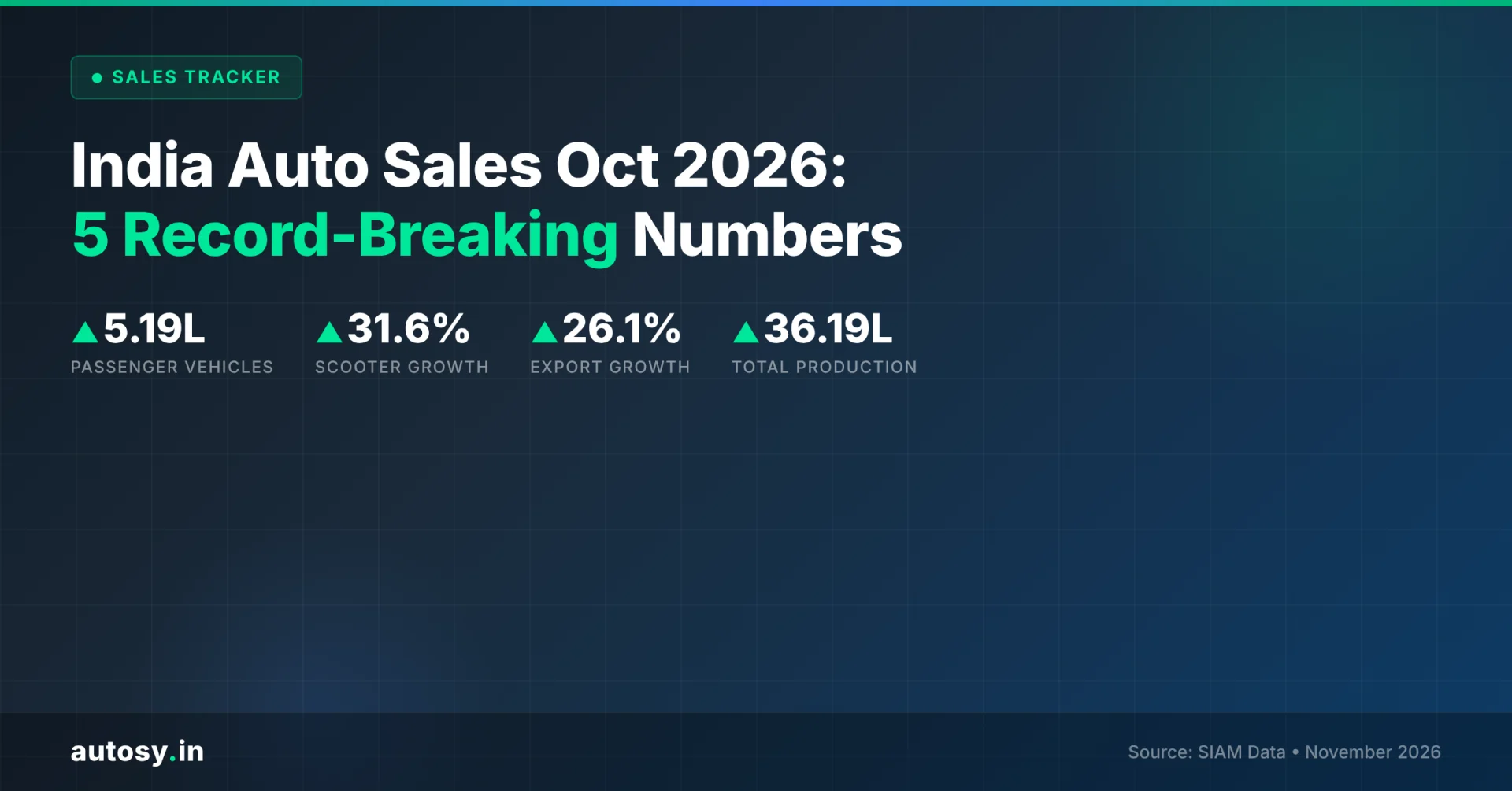
India sold more cars, scooters and three-wheelers in October 2026 than in any previous October on record. The Society of Indian Automobile Manufacturers (SIAM) released the monthly data on November 13, and the headline number tells the story: passenger vehicle sales hit 5,19,060 units, crossing the 5 lakh mark for the first time in the month’s history. That’s a 12.4% jump from October 2025, when the industry dispatched 4,61,614 units. Two-wheelers, three-wheelers, production, and exports all posted double-digit growth alongside it.
October included the Navratri and Dussehra buying window, traditionally one of the strongest periods for vehicle purchases across India. But this wasn’t just a festive spike. Cumulative numbers from April through October show the growth is structural, and the data from SIAM’s press release confirms broad-based momentum across every segment.
Passenger Vehicles Cross 5 Lakh Units for the First Time
The passenger vehicle segment’s 5.19 lakh unit performance is a milestone that had been building for months. Utility vehicles drove the bulk of the volume, accounting for 3,01,141 units with 11.4% year-on-year growth. Passenger cars (sedans and hatchbacks) contributed 1,30,305 units, up 11.8%, while van sales came in at 13,720 units with a modest 1.4% increase.
SIAM’s figures exclude data from BMW, Mercedes-Benz, Jaguar Land Rover and Volvo Auto. Tata Motors’ overall total is included in the 5.19 lakh figure, though a detailed sub-segment breakup for the company wasn’t available in the October release.
Without Tata Motors’ breakup, the remaining manufacturers accounted for 4,45,166 units, compared with 4,00,480 in October 2025. That 11.1% growth among non-Tata brands confirms the trend isn’t driven by any single company.
Brand Scorecard: Maruti Leads While Tata and Mahindra Fight for Second
Maruti Suzuki posted 2,12,384 units in October, a 20.5% jump from 1,76,318 units a year ago. The company’s utility vehicle sales grew 26.1% to 97,787 units, reflecting the continued shift from sedans and hatchbacks to SUVs and crossovers even within India’s largest carmaker.
Tata Motors finished October with 73,894 units (up 20.9%), narrowly ahead of Mahindra at 73,338 units (up 2.4%). Mahindra’s growth looks modest in percentage terms, but its October 2026 number marks the company’s highest-ever monthly domestic SUV dispatch, a record worth noting given the increasingly competitive SUV space. The company’s upcoming electric SUV lineup could add another growth layer in coming months.
Hyundai registered 62,799 units (up 16.7%), Kia posted 33,462 (up 13.2%), and Toyota dispatched 29,521 units, one of the few brands to post a year-on-year decline (down 26.7%). Among smaller players, Nissan stood out with 49.9% growth to 3,600 units.
Scooters Steal the Show in Two-Wheeler Sales
The two-wheeler segment’s 16.1% growth to 25,77,810 units masks a striking divergence. Scooters grew 31.6% to 10,96,756 units, nearly three times the pace of motorcycles, which managed 6.6% growth to 14,23,118 units. Mopeds added 57,936 units, up 13%.
Several factors explain why scooters are outrunning motorcycles by such a wide margin. Urban commuters are gravitating toward automatic, lightweight options that work better in congested city traffic. Electric scooters have expanded the addressable market by pulling in buyers who might not have considered a two-wheeler at all. And manufacturers like Ola Electric, TVS and Bajaj have widened their scooter portfolios significantly over the past 18 months.
SIAM Director General Rajesh Menon pointed to “improved credit availability and replacement demand, across both rural and urban markets” as key demand drivers for the segment. The credit part matters because scooter finance has become far easier to access through digital lending platforms, reducing the upfront barrier for first-time buyers in smaller cities and towns.
The scale of the scooter shift shows up in the export numbers too. Scooter exports hit 85,292 units in October, an 80.4% surge from 47,274 a year ago. That’s not a rounding error. Indian manufacturers are clearly building scooter capacity for both domestic and overseas demand.
Three-Wheelers Grow 26%, but E-Rickshaws Decline
Three-wheeler sales rose 25.7% to 1,03,349 units, with passenger carriers and goods carriers both posting above 26% growth. The segment’s electrification story remains intact, though e-rickshaw sales fell 22.3% to just 1,178 units as state governments tighten registration and safety norms, pushing buyers toward formal electric three-wheelers instead.
Production and Exports Post Strong Gains
Total production across passenger vehicles, three-wheelers, two-wheelers and quadricycles hit 36,18,753 units, up 28.6% from October 2025. That’s notably faster than the 15.7% growth in domestic sales, meaning manufacturers are building inventory ahead of the Diwali season and ramping up for export orders.
Every sub-segment grew: passenger vehicles up 26.3% to 5,09,910 units, two-wheelers up 28.9% to 29,48,471 units, three-wheelers up 31.3% to 1,58,416 units.
On the export front, the industry dispatched 6,82,299 units overseas, up 26.1%. Two-wheeler exports led at 5,43,972 units (up 26.5%), passenger vehicle exports grew 21.8% to 83,716 units, and three-wheeler exports rose 26.7% to 53,039 units.
April to October Numbers Point to a Record Year
The cumulative performance reinforces the monthly trend. Between April and October 2026, passenger vehicle sales totaled 30,82,634 units, a 25.5% increase from 24,56,108 units in the same period of the previous fiscal year. Two-wheeler sales reached 1,46,64,622 units (up 17.4%), and three-wheeler sales stood at 6,05,211 units (up 26.2%). Total exports during the seven-month period climbed 28% to 46,59,799 units, compared with 36,41,025 units a year ago.
The Federation of Automobile Dealers Associations (FADA) has projected that auto retail volumes in calendar year 2026 could cross the 3 crore unit mark. That would be another first.
India’s electric vehicle segment is adding its own layer on top. Electric car sales surged 76% in October 2026 to 37,049 units, with EV penetration rising to 7.3% of all passenger vehicles. Overall volumes and EV adoption are climbing together.
What the Numbers Mean for Buyers
High volumes give dealerships less room to inflate prices through accessories bundling or mandatory insurance upsells. Waiting periods on popular SUVs have been easing too: Maruti’s utility vehicle sales grew 26.1% in part because production has caught up with demand on models like the Brezza and Fronx.
In the scooter market, the 31.6% growth means manufacturers are fighting for share, which translates to competitive EMI options and better features for buyers weighing their first two-wheeler purchase. With Diwali still ahead in the current sales month, November could push these numbers even further before March 2027.
