2026 Toyota Innova Hycross Facelift: Launch Date, Price, Specs and What’s New
What is Changing in the 2026 Toyota Innova Hycross Facelift?
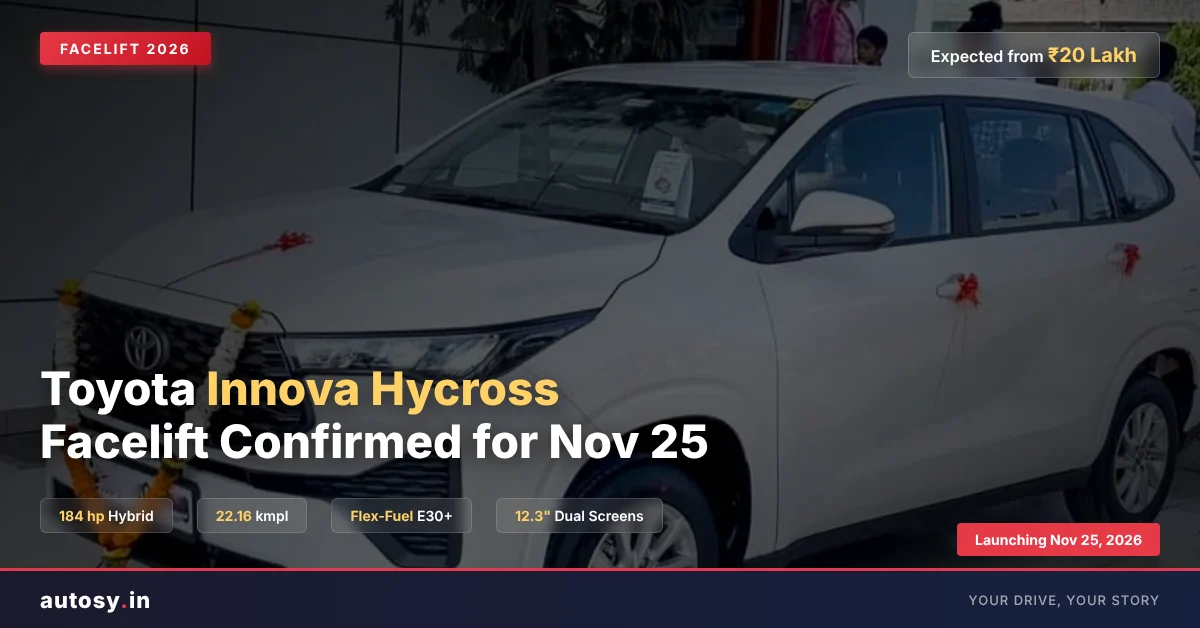
Toyota has confirmed that the facelifted Innova Hycross will launch in India on November 25, 2026. This is the first major update for the MPV since it arrived in late 2022, and the changes go beyond cosmetic tweaks. The updated model is expected to introduce a flex-fuel strong hybrid powertrain, making it the first mass-market car in India to combine strong hybrid tech with ethanol compatibility. That alone makes this launch significant for anyone tracking India’s push toward alternative fuels.
The current Innova Hycross remains one of India’s best-selling premium MPVs, priced from ₹18.70 lakh to ₹31.84 lakh (ex-showroom). Toyota recently refreshed the Indonesian-spec Kijang Innova Zenix with bigger screens and interior updates, and the India-spec facelift is expected to follow a similar path while also bringing India’s growing hybrid segment something no other carmaker offers yet.
Exterior Design: Sharper, More Aggressive
Multiple spy shots and a design patent from Toyota show a heavily revised front fascia. Toyota has gone with a squarer, larger grille that borrows from the Toyota Hilux, swapping the current chrome slats for a honeycomb mesh pattern. Slimmer headlamps with new projector units flank the grille, giving the Innova Hycross 2026 facelift a wider, more planted look.
Toyota has also reworked the front bumper, adding pixel-style LED fog lamp housings and diamond-shaped elements on either side. The LED tail lamps at the rear sport a new treatment, with a central trim piece linking them across the tailgate. New alloy wheel designs complete the exterior refresh. Everything else along the sides, the wheel arch cladding, shark fin antenna and ORVM-mounted turn indicators, stays the same.
Interior and Features: Bigger Screens, Same Comfort
Twin 12.3-inch displays steal the show inside. The touchscreen infotainment unit jumps from 10.1 inches to 12.3 inches, and hybrid variants should get a fully digital 12.3-inch driver’s display that replaces the dated analogue dials and 7-inch MID combo. Toyota has also updated the infotainment software, mirroring what it rolled out on the recently launched Indonesian-spec model.
Toyota keeps the same dashboard layout and three-spoke steering wheel, but adds new seat upholstery and fresh interior colour options. Both 7-seater and 8-seater configurations continue. The panoramic sunroof, ventilated front seats, 8-way power-adjustable driver seat, JBL audio system, multi-zone AC, powered tailgate and 360-degree camera all carry forward from the current model.
Safety stays strong. Toyota will likely retain the outgoing model’s 5-star Bharat NCAP rating, 6 airbags as standard, ISOFIX child seat mounts, electronic stability control (ESC), hill-hold assist, all-round parking sensors and Level 2 ADAS under Toyota Safety Sense.
Powertrain: Same Engines, New Flex-Fuel Capability
Toyota sticks with the existing powertrain lineup. The 2.0-litre naturally aspirated petrol engine makes 173 hp and 209 Nm, paired with a CVT. The 2.0-litre strong hybrid puts out a combined 184 hp and 188 Nm through an e-CVT. Both options drive the front wheels on the same monocoque TNGA platform.
The real story sits under the hood of the hybrid. Toyota showed an ethanol-compatible Innova Hycross hybrid prototype back in 2024, running on petrol blended with over 20% ethanol. The facelifted hybrid should support E30 or higher ethanol blends, making it India’s first flex-fuel strong hybrid production car. That move lines up neatly with the Indian government’s push to increase ethanol blending in petrol, which currently targets E20 as the national standard.
For reference, the current hybrid returns a claimed 22.16 kmpl (ARAI), while the petrol variant manages 16.13 kmpl. It remains to be seen whether the facelift brings any efficiency improvements beyond the flex-fuel upgrade.
Specifications at a Glance
| Specification | Petrol | Strong Hybrid |
|---|---|---|
| Engine | 2.0L NA Petrol | 2.0L Strong Hybrid |
| Power | 173 hp | 184 hp (combined) |
| Torque | 209 Nm | 188 Nm (combined) |
| Transmission | CVT | e-CVT |
| Drivetrain | FWD | FWD |
| Fuel Efficiency (ARAI) | 16.13 kmpl | 22.16 kmpl |
| Fuel Tank | 52 litres | |
| Wheelbase | 2,850 mm | |
| Length | 4,755 mm | |
| Ground Clearance | 179 mm | |
| Seating | 7 or 8 | |
| Boot Space | 300 litres | |
Expected Price and Rivals
Expect the facelift to start around ₹20 lakh (ex-showroom), a slight bump over the current model’s ₹18.70 lakh base price. Autocar India pegs the upper end at around ₹34 lakh for the top-spec hybrid variant. How Toyota prices the flex-fuel capability will matter: a dedicated flex-fuel variant would cost more than simply rolling the upgrade into the existing hybrid range.
The Innova Hycross facelift goes up against its rebadged sibling, the Maruti Invicto (from ₹25.02 lakh), which Maruti will likely update in tandem. Buyers cross-shopping in the broader family car space will also weigh the Mahindra XUV 7XO and the Kia Carens Clavis. Meanwhile, the diesel-powered Toyota Innova Crysta stays on sale for buyers who prefer a rear-wheel-drive layout.
Should You Wait for the Facelift?
If you have already booked an Innova Hycross and your delivery window falls in November or December, wait. The facelift brings larger screens, a fresher exterior and potentially a flex-fuel hybrid option that keeps your purchase relevant as ethanol blending standards evolve. Toyota runs long product cycles, so this mid-life update should carry the Innova Hycross for another three to four years.
For those shopping in the ₹20-30 lakh MPV space right now, the outgoing model might be available with attractive year-end discounts at dealerships, which could make it a value pick. Either way, the Innova Hycross continues to set the benchmark in its segment for space, ride quality and long-term reliability.
