Kia India’s Rs 18,800 Crore 2nd Plant: 5 Key Details
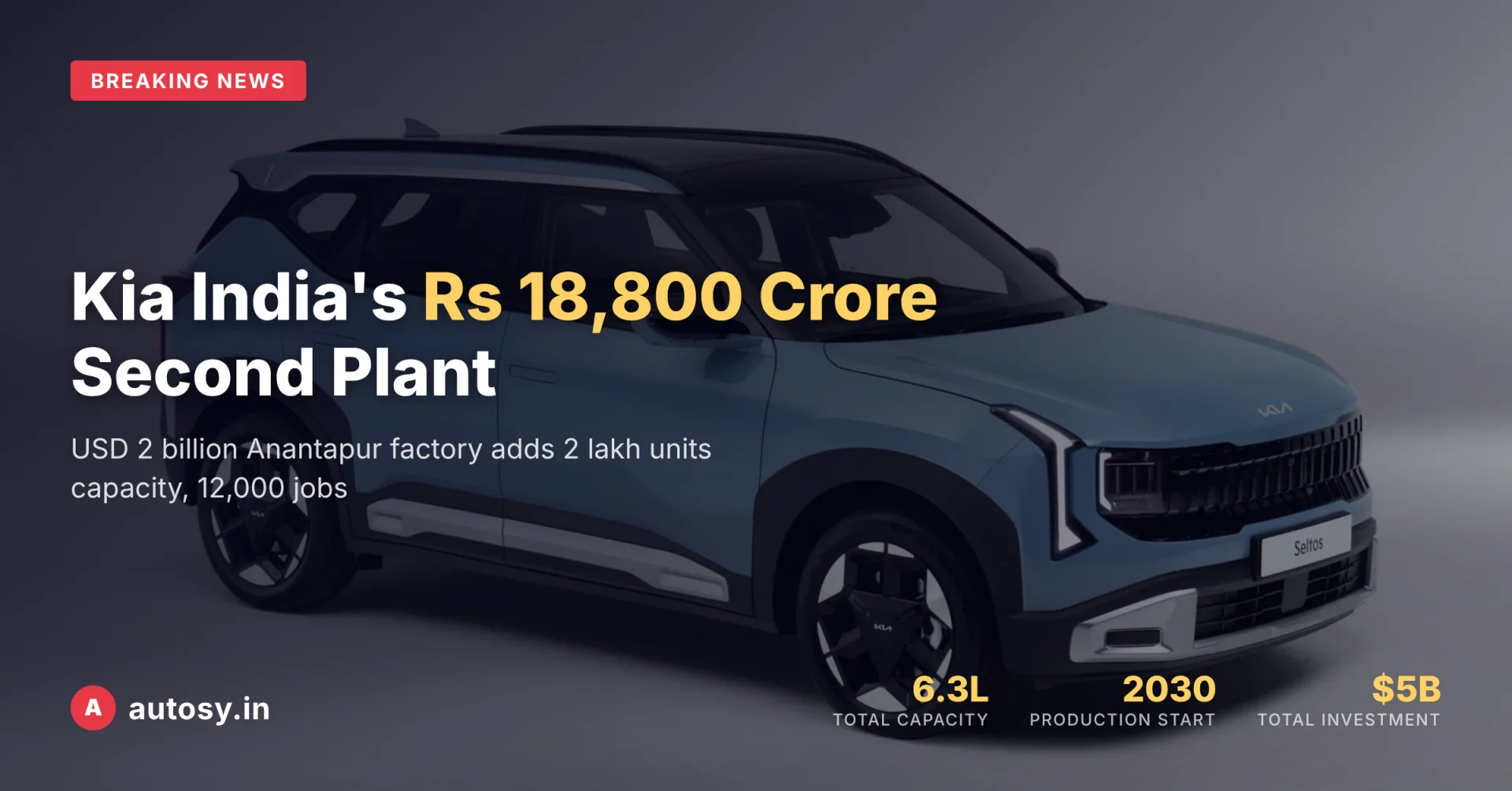
Kia India just made its biggest bet on the Indian market yet. The Korean carmaker has signed a Memorandum of Understanding (MoU) with the Andhra Pradesh government to build a second manufacturing plant in Anantapur. Kia and its supplier partners will collectively invest USD 2 billion (approximately Rs 18,800 crore) in the project, which will add 2 lakh vehicles of annual production capacity and create roughly 12,000 direct and indirect jobs.
What the New Kia Anantapur Plant Brings
The proposed facility will spread across 465 acres and handle four core manufacturing processes: stamping, welding, painting and assembly. These are the same operations running at Kia’s existing Anantapur factory, which already covers 945 acres and churns out models like the Seltos, Sonet, Syros, Carens, Carens Clavis, Carnival and Sorento.
With the new plant, Kia India’s combined annual manufacturing capacity jumps to 6.3 lakh units. The existing plant contributes 4.3 lakh units, while the new facility adds another 2 lakh. That’s a 47% bump in total output, giving Kia significantly more room to meet growing domestic demand and expand its export footprint.
Both ICE and Electric Models on the Production Line
Kia has confirmed that the second plant will manufacture new models across internal combustion engine and electric vehicle powertrains. The company hasn’t named specific models yet, but the timing lines up with its broader electrification push in India.
The existing Anantapur plant already produces electric variants of the Syros and Carens Clavis, CNG versions of the Carens and Carens Clavis, and the hybrid Sorento. Kia’s India roadmap calls for eight electrified models, covering both hybrids and battery EVs, by the end of this decade. The Seltos Hybrid is expected to arrive in 2027, followed by hybrid versions of the Sonet and Carens by 2029. Another locally produced small electric SUV is also in the pipeline for 2029.
India’s electric vehicle market has been growing rapidly, with October 2026 recording yet another strong month for EV sales across brands. Kia clearly wants a bigger slice of that expanding pie.
USD 5 Billion: Kia’s Total India Commitment
The numbers tell a compelling story. Kia pegs its initial investment at the first Anantapur site at USD 2.9 billion. Adding the USD 2 billion earmarked for the second facility and its supplier ecosystem pushes the cumulative figure to roughly USD 5 billion (around Rs 47,000 crore). That makes Kia one of the largest single investors in Indian automotive manufacturing.
The first plant, operational since 2019, supports 24,237 direct and indirect jobs, according to Kia. The second plant’s 12,000 additional jobs bring the combined employment impact to over 36,000 positions. For Anantapur district, which has become a genuine automotive hub, this expansion cements the region’s importance on India’s manufacturing map.
Gwanggu Lee, Managing Director and CEO of Kia India, said the second plant would give the company “greater speed and flexibility” in responding to customer demand while supporting the introduction of new ICE and EV models. He added that the expanded manufacturing base would serve both Indian and overseas markets.
Production Timeline and Market Targets
Production at the new facility is slated to start in early 2030. That’s roughly three years away, which gives Kia enough runway to complete construction and set up the supplier ecosystem before finalizing model allocation across the two plants.
Kia’s previously announced India roadmap targets annual sales of roughly 4.1 lakh units and a 7.6% market share by 2030. October 2026 was already a record month for the company, and the brand has steadily climbed India’s sales charts since launching the Seltos back in 2019.
The timing of this announcement follows a pattern. It comes after Hyundai Motor Group’s broader pledge from October 2026 to invest USD 15.5 billion in India between 2026 and 2032. That parent company programme covers manufacturing and R&D alongside supplier localisation for both Hyundai and Kia. The Kia plant MoU puts a specific location, timeline and capacity figure on the Korean automaker’s next phase of Indian expansion.
Why This Matters for Indian Car Buyers
More factory capacity doesn’t just mean more cars. It often translates into shorter waiting periods and quicker rollouts of new models. More competitive pricing could follow as economies of scale kick in.
With several Chinese and global brands entering the Indian market alongside established players, competition is intensifying. Kia’s capacity expansion signals that it plans to fight for market share with volume and speed to market.
The dual ICE and EV capability is particularly smart. India’s car market still runs primarily on petrol and diesel, but the electric segment is growing fast. Building a plant that handles both ensures Kia can pivot its production mix as consumer preferences shift, without being locked into a single powertrain strategy.
For now, the specific models destined for the new plant remain under wraps. But with Kia’s track record of launching a new product almost every year since 2019, the expanded capacity should translate into a broader and more diverse lineup for Indian buyers by the early 2030s.
