2027 Hyundai Creta Interior Spied in India: 5 Big Changes Revealed
Key Highlights
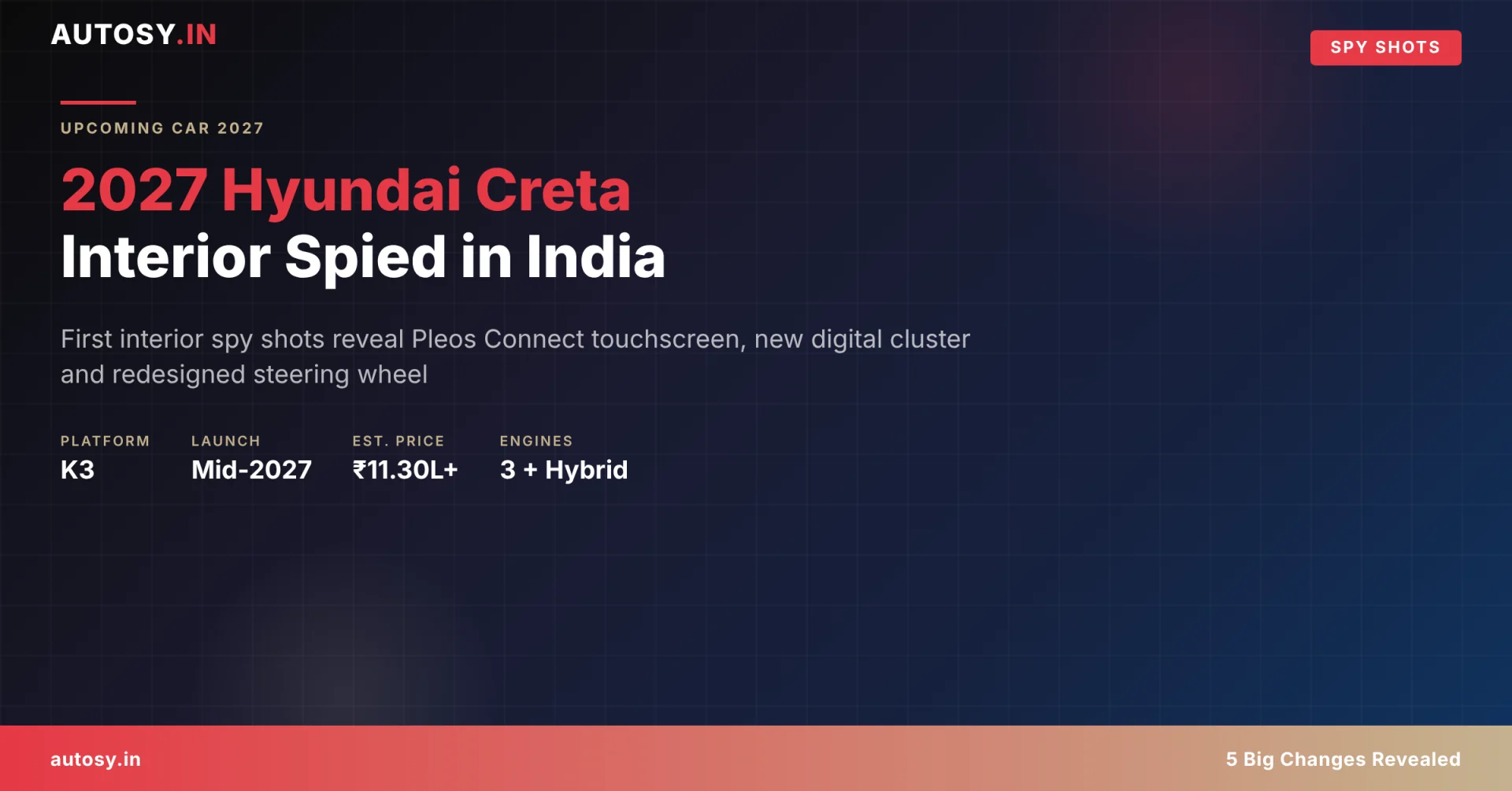
The next-generation Hyundai Creta has been caught testing near Manali with its cabin fully exposed. These are the first interior spy shots of the 2027 Hyundai Creta in India, and they confirm a complete redesign.
The dual-screen layout from the current car is gone. In its place: a large standalone Pleos Connect touchscreen, a slim digital instrument cluster and a new steering wheel pulled from Hyundai’s global parts bin.
MH14 registration plates on the test mule point to Hyundai’s Talegaon plant in Pune. More units have turned up in NCR and Gurugram over recent weeks. Built on the K3 platform shared with the next Kia Seltos, this third-generation Creta grows in both width and length compared to the car on sale today.
Hyundai plans an India launch by mid-2027, with starting prices expected around Rs 11.30 lakh.
What the Interior Spy Shots Reveal
The infotainment system is the biggest change. Hyundai has replaced the current car’s dual-screen arrangement with a single large Pleos Connect touchscreen sitting at the centre of the dashboard. Pleos Connect, already running in the international Tucson facelift, supports over-the-air updates and drops BlueLink’s older interface for something cleaner.
Response times appear faster in the Tucson units overseas, though we’ll have to wait for the India-spec software to know if that carries over here.
Physical controls below the screen? Almost none. A rotary dial on the centre console handles what appears to be drive mode or climate adjustment. The console itself floats, opening up storage underneath.
This test car wore an off-white and black interior. Expect at least two or three colour themes at launch.
Then there’s the driver’s display. The conventional instrument cluster from today’s Creta is out, replaced by a slim, wide digital panel that sits high on the dashboard. It reads almost like a head-up display projected onto a physical screen, keeping speed and navigation data closer to the driver’s natural line of sight.
In bumper-to-bumper city traffic, that positioning makes a real difference. Autocar India first reported these new Creta spy shots from their exclusive set.
Steering Wheel and Controls
The steering wheel is worth a closer look. At its centre sits Hyundai’s updated Morse Code ‘H’ logo, the one that debuted on the Staria and has since rolled out across newer global models. Two scroll wheels replace the rocker buttons on today’s car.
Touch-sensitive pads fill the remaining spoke area, and what look like paddle shifters peek out behind the wheel. The overall feel is chunkier, closer to the Ioniq 5’s wheel than the relatively thin unit in the current Creta.
For a car that starts under Rs 11 lakh, that’s a notable step up in perceived quality.
Exterior Design Changes Spotted Earlier
These interior spy shots followed weeks of exterior sightings. Earlier images from Autocar India revealed a boxier front end that borrows from the Hyundai Venue’s latest facelift: wider grille, more upright stance, split LED headlamps up top with main lights set lower in the bumper.
Round the back, three-segment LED taillights stretch across the width, connected by a light bar. Flush door handles. ORVMs with 360-degree camera pods built in. Sportier alloy wheels in a pattern no current Hyundai in India uses.
The functional detail that matters most is the central ADAS radar module behind the front grille. That points to Level 2 autonomous driving features on higher trims, a first for any Creta sold in India. Forum members on Team BHP have tracked multiple test mules, and the ADAS hardware has appeared on every single one.
Engine and Gearbox Options
Hyundai will carry over its existing engine family with updates for tighter emission norms. Three options at launch: a 1.5-litre naturally aspirated petrol making 115 hp (the volume seller), a 1.5-litre turbo-petrol at 160 hp and a 1.5-litre diesel rated at 116 hp. Diesel still accounts for roughly 18% of SUV sales in India, so dropping it was never really on the table.
The bigger story is the strong hybrid. Expected within a year of the standard launch, it pairs the 1.5-litre NA petrol with an electric motor, much like the Maruti Grand Vitara and Toyota Hyryder setup. Claimed efficiency should land above 20 km/l. That’s Hyundai’s direct counter to two cars that have been chipping away at the Creta’s dominance in this segment.
Gearbox choices: 6-speed manual, CVT for the NA petrol, 7-speed DCT for the turbo, 6-speed torque converter auto for the diesel. Rushlane noted that all test mules spotted so far ran automatics, so manual calibration likely comes later.
Expected Price and Launch Timeline
The current Hyundai Creta 2027’s predecessor sits between Rs 10.99 lakh and Rs 20.30 lakh (ex-showroom). The new car will cost more. Base variant? Expect around Rs 11.30 lakh. The top-spec turbo-petrol will likely cross Rs 22 lakh.
Mid-2027 is the launch window. Hyundai usually shows the production car two to three months before deliveries begin, so a reveal around March or April looks likely. The Creta has been Hyundai India’s best-selling model for years, regularly moving over 14,000 units a month.
Timing the generational switch before monsoon, when showroom traffic peaks, makes commercial sense.
Rivals Lining Up
The mid-size SUV space will be packed by late 2027. Tata’s Sierra, Nissan’s Tekton, a new-generation Kia Seltos (same K3 platform as the Creta), Skoda Kushaq, Volkswagen Taigun, Maruti Grand Vitara and Toyota Hyryder all compete in the Rs 10 to 20 lakh range. On fuel efficiency, the Grand Vitara and Hyryder strong hybrids remain the ones to beat until Hyundai’s own hybrid arrives.
But watch the pricing battle. Tata and Nissan both tend to undercut established players at launch, and aggressive introductory pricing on the Sierra or Tekton could pressure the Creta’s opening month numbers.
What Buyers Should Watch For
If you’re shopping for a mid-size SUV in early 2027, wait for the Creta. The cabin alone, from Pleos Connect to that new digital cluster, puts the Hyundai Creta 2027 a generation ahead of what’s in showrooms right now. Hyundai’s after-sales network (the largest among private carmakers in India, with over 1,400 touchpoints) is the kind of advantage that doesn’t show up in a spec comparison but matters three years into ownership.
One caveat. The hybrid won’t be there on day one. If fuel efficiency is your top priority and you can’t wait six to twelve months after the Creta’s launch, the Grand Vitara hybrid is available right now. Check recent EV and hybrid sales trends to see which powertrain buyers in your segment are actually choosing before you commit.
