Before Buying a New Car: 5 Important Things to Consider in 2026
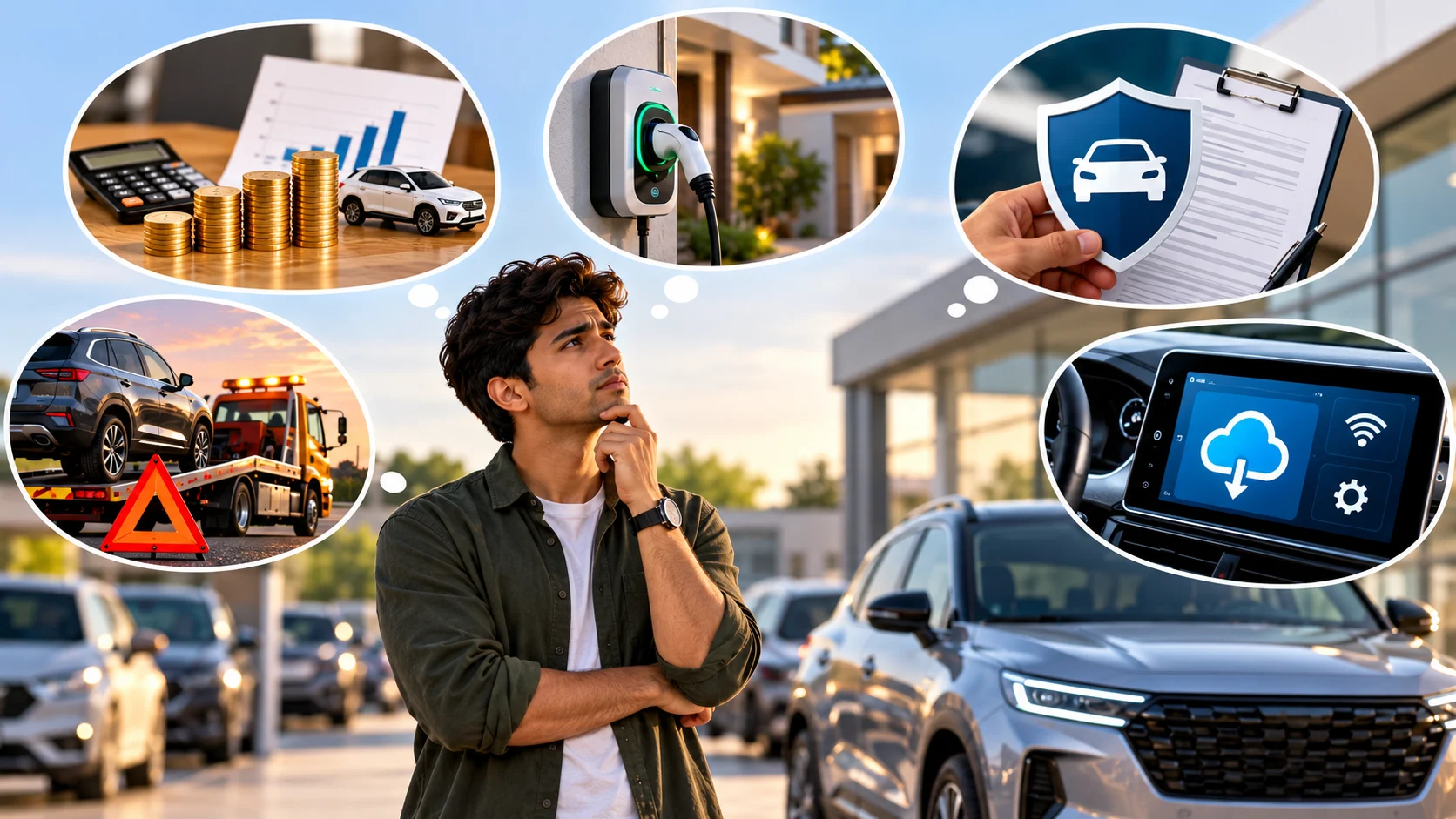
Buying a new car involves more decisions than ever before, and many buyers make costly mistakes by focusing on the wrong factors. This guide draws on insights from automotive experts to highlight the single most important consideration before making your purchase and the common pitfall that could cost you thousands. Understanding these key points will help you make a smarter decision and avoid buyer’s remorse.
- Compare Five-Year Outlay plus Depreciation
- Confirm Home Charge Access with Included Cable
- Make Insurance Part of the Purchase
- Plan for Breakdowns and Safe Recovery
- Prioritize Future-Proof Software over Hardware Subscriptions
Compare Five-Year Outlay plus Depreciation
The biggest mistake buyers make in 2026 is comparing cars by sticker price alone instead of total cost of ownership over 5 years. Using our own calculations, a car that looks $3,000 cheaper upfront can end up more expensive once you add fuel, insurance, and depreciation, and most buyers never run that math before signing.
The most important thing to check: your actual driving pattern, not a generic estimate. If you’re weighing an EV, home charging currently costs about 5.3 cents per mile at the national average electricity rate (18.44 cents/kWh), while public fast charging runs closer to 12 cents per mile, both against roughly 13.4 cents per mile for gas nationally. That gap matters a lot if you don’t have home charging access: in 10 states we’ve tracked, including Texas, Louisiana, and West Virginia, public charging is now more expensive per mile than gas, not less.
Depreciation is the other blind spot. It rarely shows up next to the price tag, but it’s usually the single largest cost of owning any new car for 5 years, bigger than fuel, bigger than insurance. Buyers who skip that number are the ones who get surprised at trade-in time.
yu myunghyeon, Founder & Editor, GearUp Insights
Confirm Home Charge Access with Included Cable
The thing to settle before signing anything is where the car will charge overnight, and whether the place you park can do it.
That sounds obvious and it is the step most buyers leave until after delivery. Off street parking with a socket makes an electric car cheap to run. On street parking, a shared car park, or a landlord who has not agreed to a charge point makes it expensive, because you then buy most of your electricity from public rapid chargers at several times the home rate. Same car, completely different running cost.
The common mistake is assuming the charging equipment comes with it. Often it does not. About 45% of the orders we take in somebody’s first week of ownership are for a cable they had assumed was in the boot. Ask the salesperson what is physically included and get the answer in writing, because the free cable mentioned in a brochure and the cable in the car are frequently different things.
One customer collected his car on a Friday afternoon, drove home pleased with himself and rang us on the Saturday because there was nothing in the boot to plug it into. He had a driveway, a charge point on the wall and no way of connecting the two until Monday.
Sort the charging before you choose the colour. The car is the easy decision.
Jake Wardle, Founder, EV Cable Hub
Make Insurance Part of the Purchase
When people shop for a new car, most of the decision-making goes into the vehicle itself: price, financing, features, maybe safety ratings. What often gets left out of that process is the insurance decision that comes with it, and that’s a mistake I see the financial consequences of regularly in my practice. The coverage you choose at the point of purchase is just as much a part of that car buying decision as the model you drive off the lot.
Specifically, California requires insurers to offer uninsured motorist coverage, but buying it is optional. It’s easy to treat that as a line item to skip when you’re already juggling a dozen other decisions on a new car. But in my work handling motor vehicle crash cases, that coverage is often the only thing standing between a client and out-of-pocket losses when the other driver has no insurance at all, including in hit-and-run accidents where there’s no other party to hold liable. Underinsured motorist coverage works alongside it, stepping in when the at-fault driver has insurance but not enough to cover what you’re owed.
The mistake isn’t which car someone buys. It’s treating the insurance conversation as separate from that decision, rather than as part of it. Before you finalize a new car purchase, review the uninsured and underinsured motorist provisions of your policy with the same attention you’d give the car itself.
Michael Akiva, Managing Partner, Jacoby & Meyers
Plan for Breakdowns and Safe Recovery
From a towing and recovery perspective, I’d encourage buyers to look beyond the features they use when everything is working and consider what happens when the vehicle isn’t driveable.
Modern cars can have specific towing procedures, electronic parking brakes, low ground clearance, AWD systems and manufacturer restrictions on how they can be transported. These factors can make a breakdown or recovery more complicated.
A common mistake is buying purely around technology, performance and the monthly repayment without understanding the vehicle’s practical ownership requirements. Before buying, check the manufacturer’s roadside and towing procedures, tyre setup and recovery requirements. You may rarely need that information, but when the car is stranded, it suddenly matters a lot.
Joshua Harrison, Founder, Underground Towing & Salvage
Prioritize Future-Proof Software over Hardware Subscriptions
The prime factor for car buyers in 2026 will be future-proofing and transparency related to vehicle digital ecosystem, instead of its mechanical features. With cars having become digital machines, the earlier concerns about power and interior materials become secondary to the way a manufacturer controls over-the-air updates, privacy of data, and integration across platforms. Working to lead transformation in digital practices and complex enterprise processes, I have witnessed how quickly an excellent digital system becomes an impediment under rigid architecture conditions. Thus, car buyers should look for the digital sustainability of the asset, which means not only checking the dashboard screens, but also understanding if the software could be transformed within the next decade or if the hardware will become obsolete by the moment financing is finished. In 2026, cars become mobile data items, and their value would depend on the quality of operating systems and their capability to receive updates.
The wrong and expensive mistake would be underestimating the total cost of digital ownership concerning hardware-locked subscriptions. There is a growing trend of incorporating hardware charges for already existing features into the subscription system. The car owner who has to pay hardware subscriptions will face problems while selling the vehicle. When I am evaluating premium assets around the world, I see that the more successful options assume the technology is always the benefit for the owner rather than an endless source of costs.
Bharat Sharma, Delivery Manager, Enterprise CX Solutions, eSignly
